

By Togzhan Baikenova, Staff Writer
Artificial Intelligence technology is increasingly becoming part of modern life and is used both by students when dealing with complex homework assignments, and by workers who use it to accomplish day-to-day tasks.
Modern universities find themselves obligated to prepare students for a future where having skills in utilizing AI could become just as important as having knowledge of computer usage. As such, they face a challenge in choosing how to introduce the topic.
Saint Leo University chose to address this challenge and developed its response strategy. Undergraduate students will be able to earn three credits towards fulfilling their required general education courses by taking either IDS-120: AI Unlocked, or IDS-125: AI, Ethics, and Society. Because those are University Explorations classes, students across all majors will work with AI before they finish their degrees.
Dr. Iona Sarieva, Bridge Program Director and associate professor of English, explained that the courses are necessary because AI is already woven into daily life.
“The AI genie is out of the bottle and has become part of our lives,” said Sarieva.
She traced the shift to Nov. 30, 2022, when OpenAI released ChatGPT to the public. The tool quickly drew attention for generating answers, explaining concepts, and finishing tasks that once took far longer. However, it also raised worries about academic honesty, critical thinking, and how much students might lean on technology instead of their own abilities.
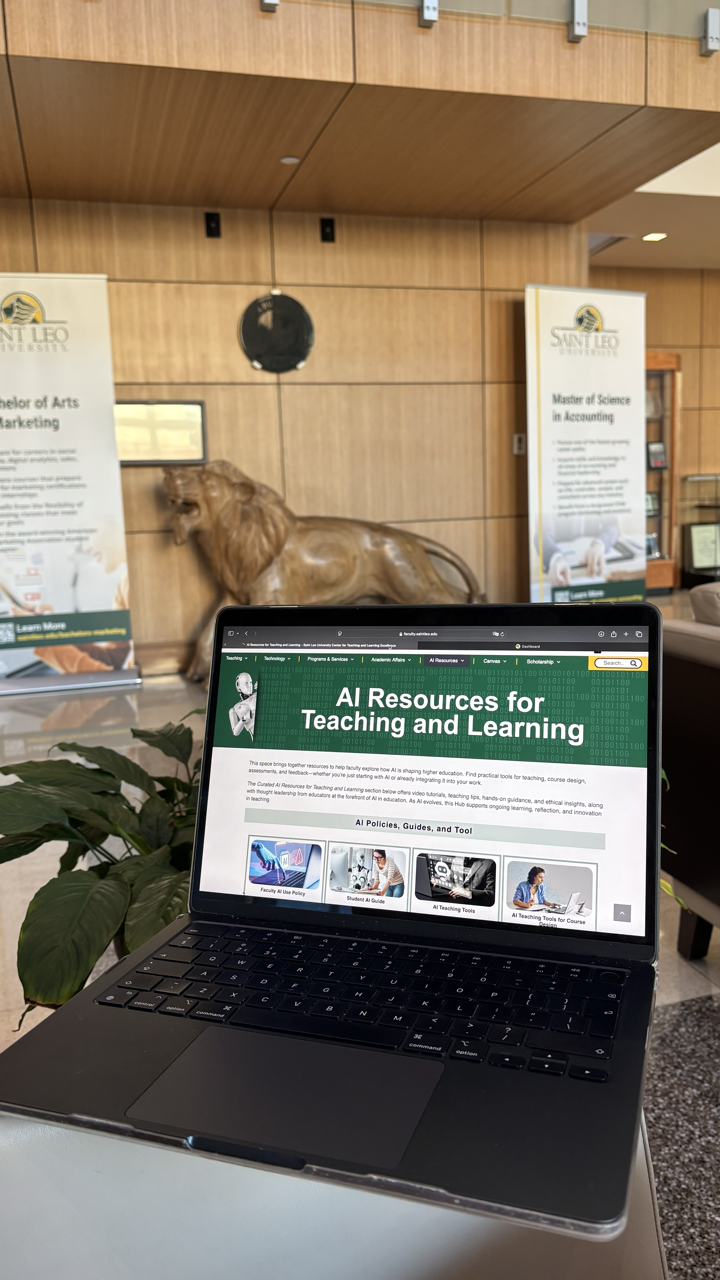
“So we all, especially students preparing for their professional careers and lives in the AI-infused world, should master the AI genie rather than letting it master us,” Sarieva said.
Students who already use ChatGPT might wonder why they need a whole course. Sarieva explained that there is more to learn than how to type a question into a chatbot.
Sarieva suggested that students should recognize how much remains unknown about AI, referring to this challenge as the “unknown unknowns.” As the technology continues to evolve, students will need to keep learning and questioning it.
She also wants students to remember that AI is not the same as human intelligence. It can produce impressive results, but people still have to use their own judgment when making decisions and evaluating information.
Students who work with technology every day share that view. Aisuluu Osmonova, a computer science major who works in Saint Leo’s IT department, explained that AI education is worth it even for students who never plan to work in tech.
“AI is becoming a part of our everyday lives, and I feel like almost every career will involve it in some way,” said Osmonova.
She named health care, business, and education as fields already using AI tools.
“Personally, I think students don’t need to know how to code or build AI systems, but they should at least understand how AI works and how to use it,” Osmonova said.
As both a student and an IT employee, she has seen how AI can make hard material easier to follow.
Students can ask for a clearer explanation of a complicated topic, and IT staff can use it to answer common questions and fix routine problems faster.
However, she does not think it can fully replace people, especially when a problem calls for critical thinking or an understanding of one person’s situation.
Accuracy is another concern.
“I personally think one of the most important things students should know is that AI is not always right,” Osmonova said. “Sometimes it gives incorrect information, even when it sounds really confident.”
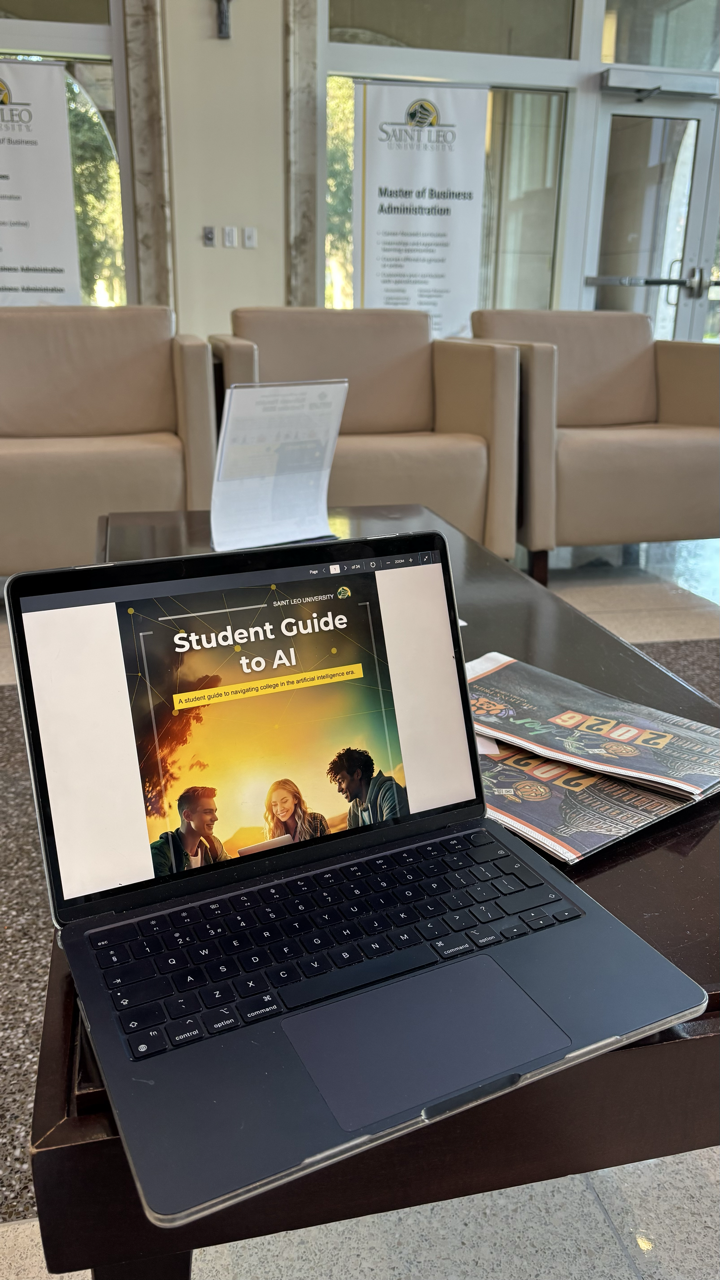
Saint Leo’s Student Guide to AI addresses the same issue by encouraging students to check information, protect personal data, follow each Professor’s AI policy, and avoid turning in AI-generated work as their own.
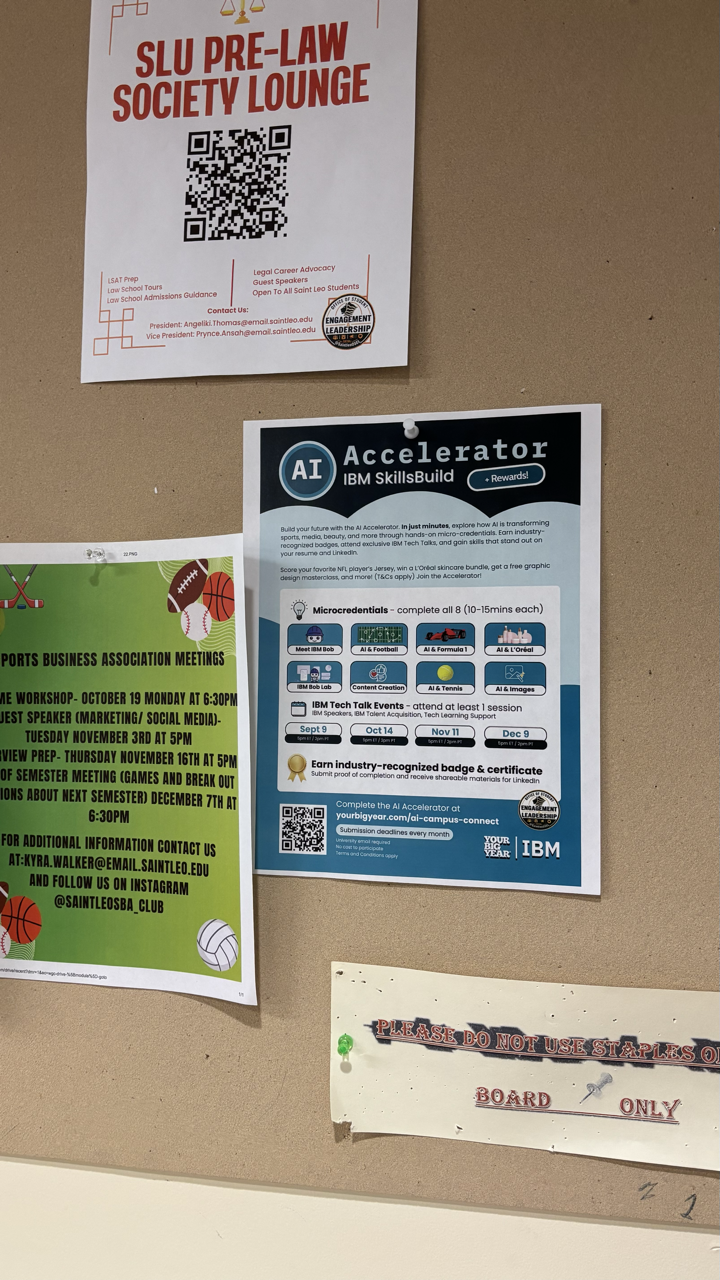
The university’s AI push goes beyond the two new courses. In March 2026, FOX 13 News reported that Saint Leo had partnered with IBM to offer AI certifications through its SkillsBuild platform. Students must complete foundational AI training and earn additional credentials tied to their fields of study.
University President Dr. Jim Burkee told FOX 13 the training is free and does not affect tuition. Graduates can also return once a year for a free certification to keep their skills current.
“That means that every graduate at St. Leo is going to come out knowing how to use AI in the workplace,” said Burkee.
Taken together, the courses, certifications, and graduate program show how seriously the university is taking AI.
For students at Saint Leo, the classes have come to be seen as an opportunity rather than just a requirement. It is a chance to learn how a technology that is already having an impact on their education may affect their work in the future.
Although AI can provide answers in seconds, students must still have the ability to think for themselves.