
By Sophia Sullivan, Editor-in-Chief
Most people have a clear view of the typical college experience. Move into a dorm at a four-year university, attend classes every day, join a club, and hang out at the campus coffee shop with friends. However, this experience is not possible or ideal for every type of student.
This is where Saint Leo University’s education centers come in. These centers make a college education possible for many by offering flexible classes and personalized support to those whose lifestyles may not fit into the “traditional” university experience.
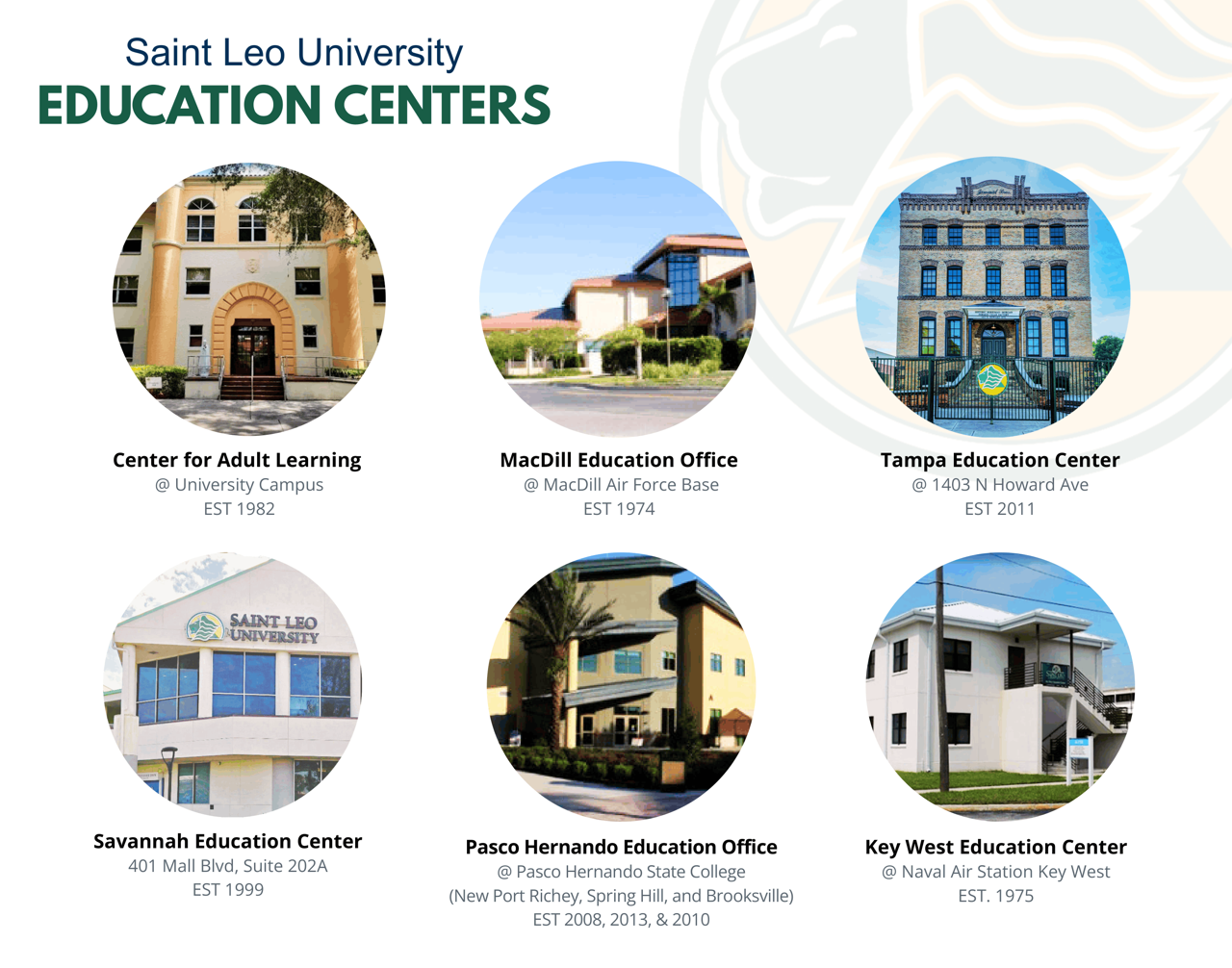
Saint Leo boasts six different Education Centers—five in Florida and one in Savannah, Georgia. One is even in the heart of the university campus.
While these centers may be situated throughout the southeastern U.S., they all come together for a common purpose—providing a flexible path to gain a quality Saint Leo education.
The students who attend Saint Leo’s education centers are not the typical “right out of high school” students. Most who attend the centers are adult learners who work full-time, have families, or are members of the military.
“Many of us are not traditional students—we’re veterans, active-duty service members, reservists, contractors, civil service personnel, and working adults—but we are still part of the Saint Leo community. These centers bridge that gap and make higher education accessible and manageable,” said Haven Greene III, a student at the Key West Education Center graduating in May with a bachelor’s in computer information systems.
Because two of the centers are located on military bases, understanding and working with military members and veterans pursuing higher education is very important.
“Working with veterans … is a really big deal for the education centers and making sure that we help them where they are,” noted Alaina Forehand, Director of Learning and Operations at Saint Leo, who previously served as Director of the Key West Education Center.
This means that classes and schedules are structured a little differently than one might see on the university campus, but the curriculum is largely the same. For instance, classes are all offered after 5 p.m., taking into consideration the number of adult learners who work regular, full-time jobs.
“So, for the most part, all of the centers have some of the same degree programs. I can speak on Key West in particular, but we have associate degrees, bachelor’s degrees, and we also offer a master’s degree here as well,” said Jeff Hite, Director of the Key West Education Center.
The centers also offer both in-person and online classes to meet the needs of different students.
“You still get that traditional experience with … other classmates, and they’re in the classroom with you. The teacher might be virtual, the teacher might be present in the room, but you’re still able to gain that college experience,” said Hite.
In short, it’s the same meaningful Saint Leo education, just delivered in a bit of a different way.
What’s not that different, though, is the sense of community still present at these centers. According to Hite, the Key West Center, for example, boasts great partnerships with companies like Margaritaville and Keys Electric.
“This community has kind of just welcomed us with open arms,” said Hite.
Not only is the surrounding community extremely supportive, but so are the people.
“That is what makes Education Centers so important. They provide a human connection in what can otherwise feel like a very impersonal process,” said Greene.
Faculty and staff tend to wear many hats at the Education Centers, serving as advisors, admissions officers, financial aid advisors, and more.
“Our footprint as an Education Center is small, and because it’s small, you know, sometimes the staff is also a smaller footprint,” said Forehand. “Whereas at, you know, university campus or online, people have specific roles, the Education Center staff are going to do it all, from prospective students to current to continuing to alumni.”
While the centers are extremely impactful, they can face some challenges compared to the university campus. One of the biggest challenges is the physical distance from the main campus in Dade City. Not all problems have the ability to be solved on university campus, so staff at the centers often have to act as a “liaison” with the main campus and maintain good communication with them to help students with their needs. Another challenge lies in the size and reach of the Education Centers. Because they are smaller, marketing can be difficult.
“Because the footprints smaller, the budgets are smaller for marketing … you also have to be creative in how you get your name out there,” said Forehand.
And that is the beauty of Saint Leo’s Education Centers—they adapt, boast flexibility, and maintain the quality of education that Saint Leo is known for. As the horizons continue to broaden for Saint Leo, so does the outlook of their Education Centers around the country.
“I know our new leadership is looking at opening new education centers as well, so that opportunity to create close relationships is monumental in people’s lives, in ways that you know sometimes you’ll never know,” said Forehand.