
By Elijah Penn, Editor-in-Chief
“People who rarely speak at public meetings stood up and found their voice. That doesn’t happen by accident,” said Saint Leo University president Dr. Jim Burkee. “It reflects how deeply this community cares about who they are and what they want to protect.”
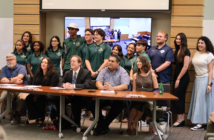
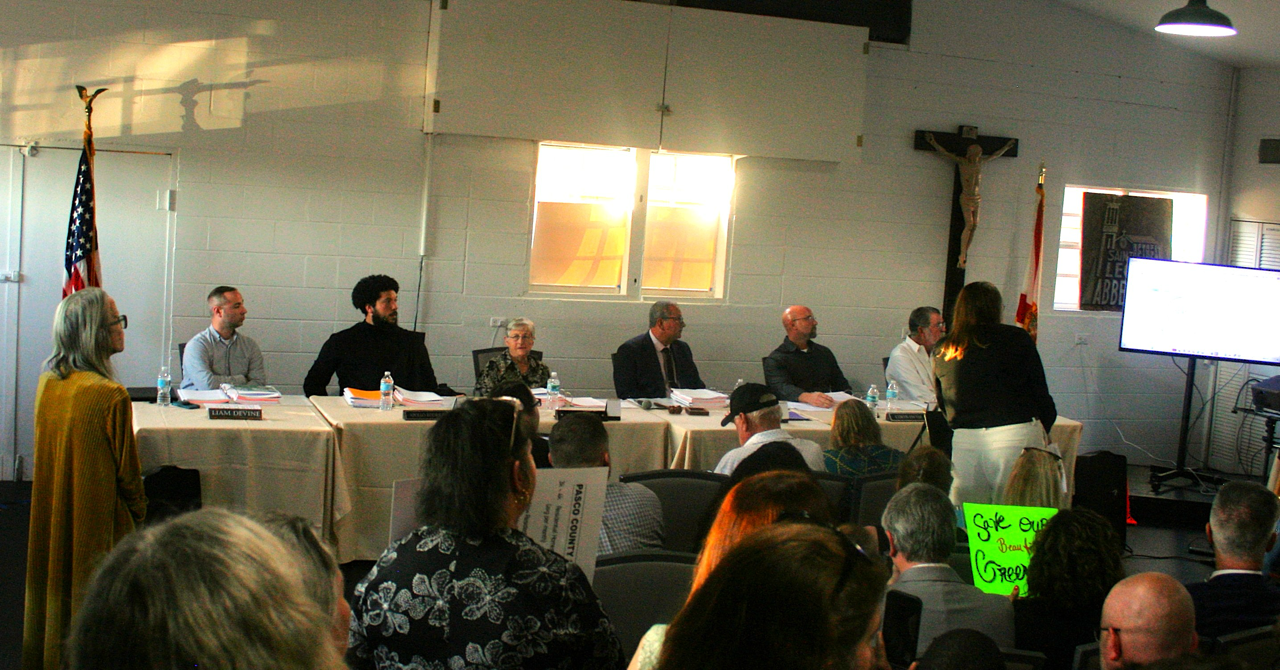
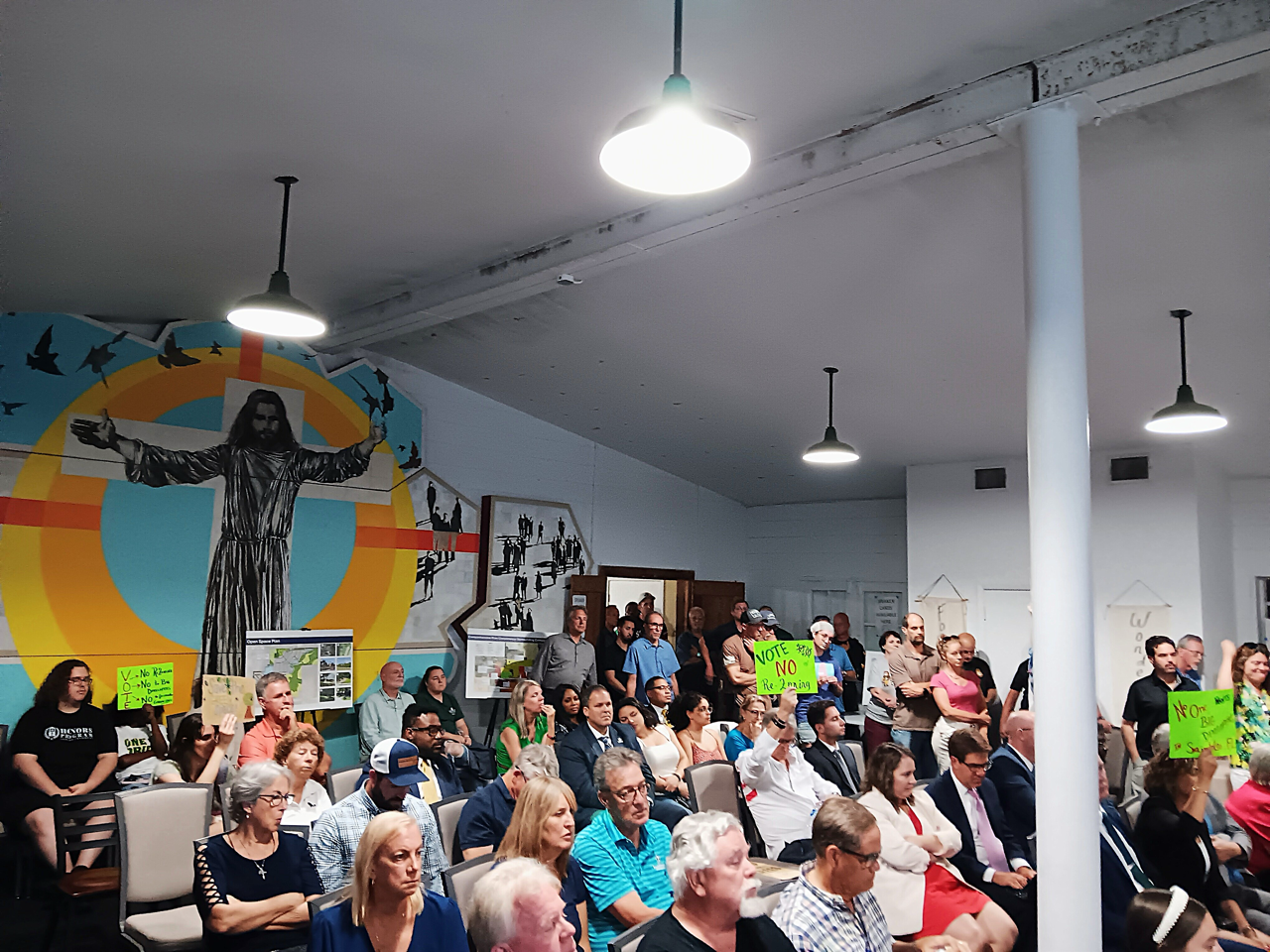
Approximately 200 people crammed into Saint Leo Abbey Carpenter’s Shop at 7:30 p.m. for the St. Leo Town Commission hearing on the fate of the Abbey Golf Course.
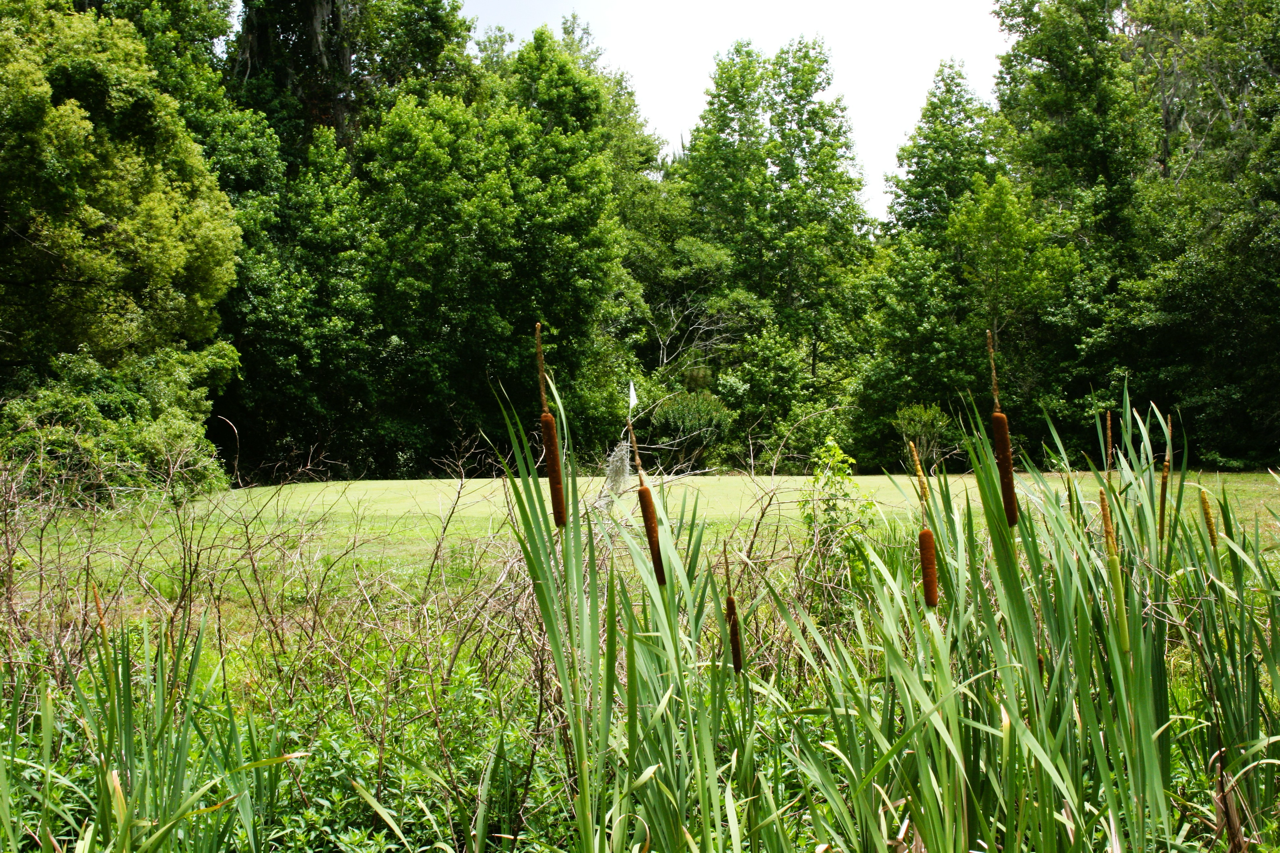
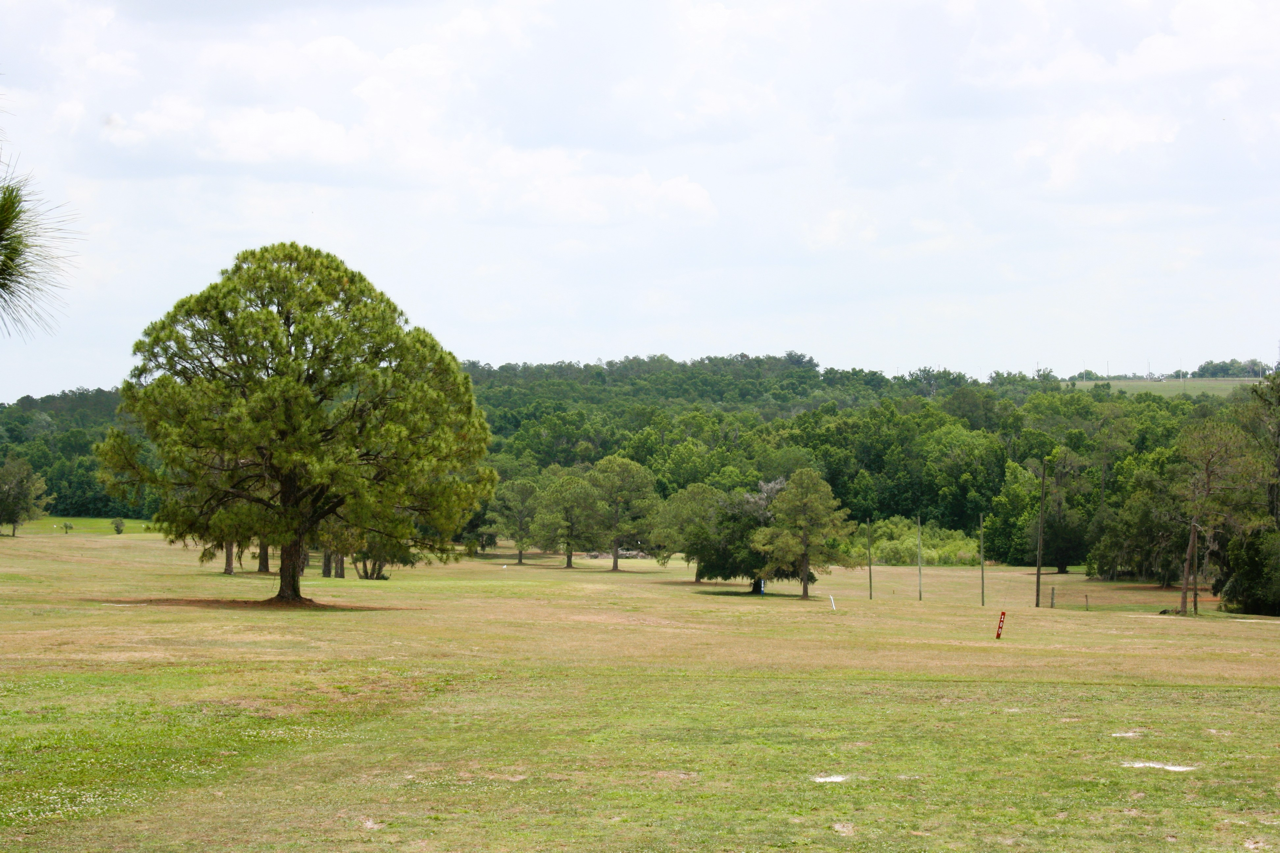
The primary item on the agenda of the May 13 meeting was the request by Ryan Homes, a development company with a presence in several southeastern states, to amend the Town of St. Leo’s Comprehensive plan. This amendment would allow the Abbey Golf Course to be rezoned in the future from a “Permanently Open Land” designation to “Planned Unit Development.” This would allow a future subdivision, called “Mohr’s Crossing,” to be built on the site. Rev. Charles Mohr, O.S.B. became the first president of the first college at Saint Leo in 1890, according to the Saint Leo University website.
Following the hearing, the St. Leo Town Commission voted to deny sending the proposed amendment to the state review board, effectively thwarting rezoning efforts by Ryan Homes.
Due to announcements and mass communication against the proposal by Saint Leo University and coverage of the planned development by local news organizations, the word quickly spread to residents across the county.
The awareness about the proposal created a public outcry from residents frustrated with numerous new developments being built across the county. The threat of losing a greenspace promised in “perpetuity,” surrounded by several large, planned future developments, galvanized residents to act.
The crowd filled the room and even spilled out into the adjoining room and outside of the building. The hearing drew community and political leaders from St. Leo, surrounding communities such as Dade City and San Antonio, and even county-wide figures.
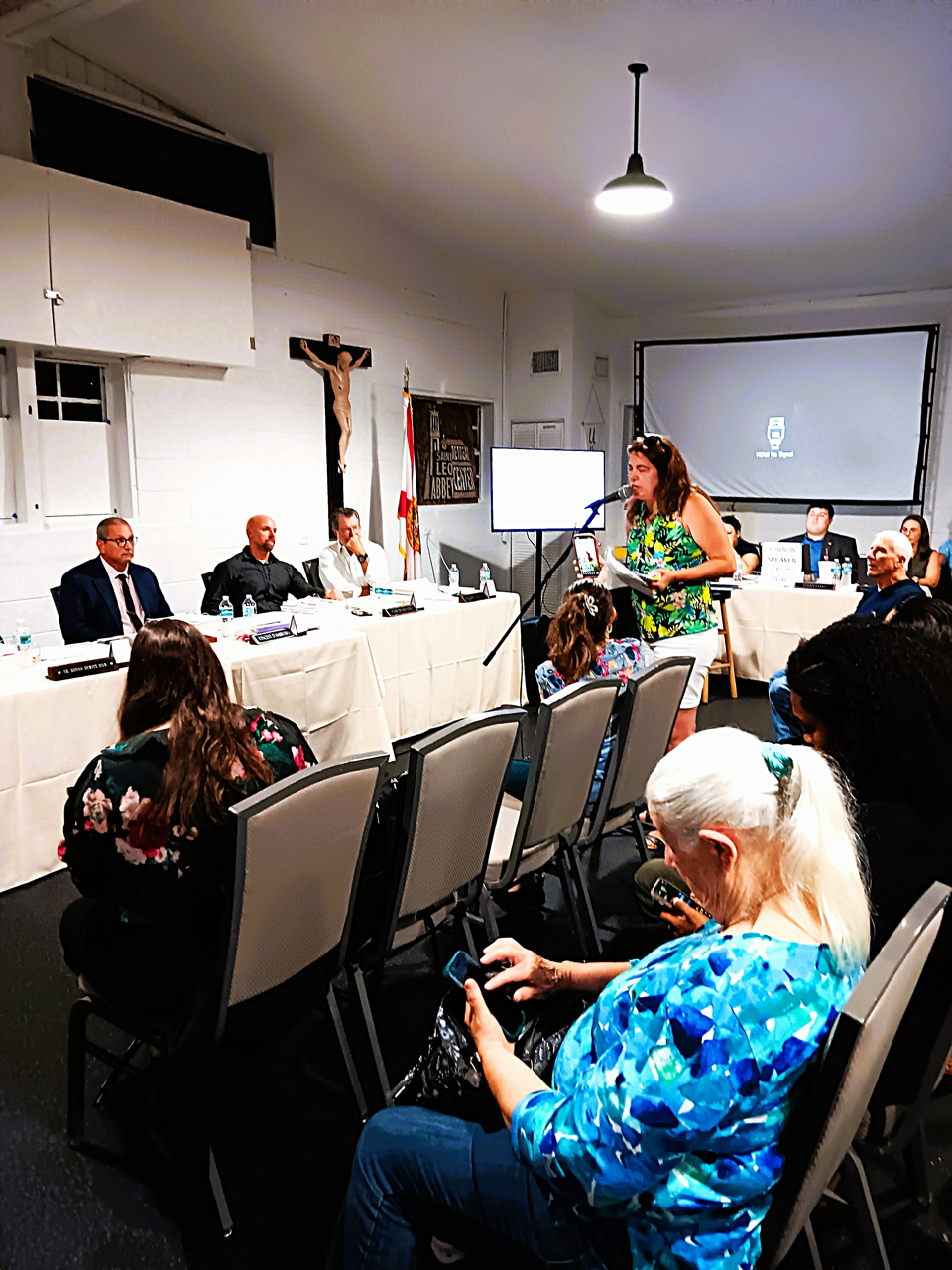
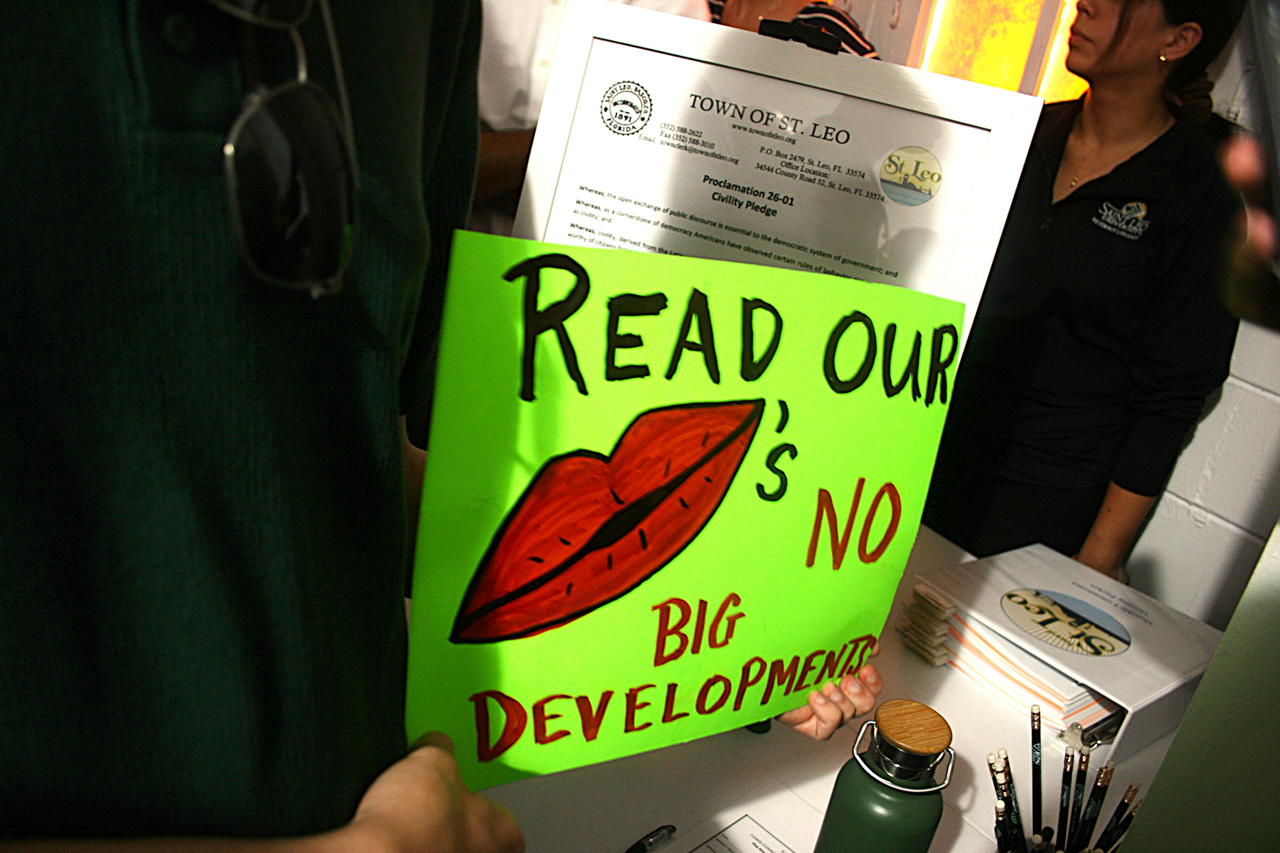
Prior to the start of the hearing, attendees broke out in chants of “illegal” against the proposed subdivision. Many people also held signs in protest. During the public comment portion of the meeting, more than 40 people registered to speak.
Following the hearing and rebuttal, commissioners Donna DeWitt, O.S.B., Vincent D’Ambrosio, Curtis Dwyer, and William Hamilton voted in favor of denial, while Commissioner Apollo Rodriguez, O.S.B., was recused from voting as the signee for the property in question.
Apart from the initial chants, Saint Leo University senior medical humanities student Timothy Conneally was surprised by how respectful the attendees were. Conneally, who also addressed the commission during public comment, said the issue felt deeply personal to him.
“I chose to speak at this hearing as Saint Leo has become incredibly important to me over the course of my time as a student at the university,” said Conneally. “Watching a part of this community get bulldozed for development is something that did not sit right with me, and I knew I had to speak up.”
Conneally believes that this proposal is part of a similar trend he has witnessed across the state.
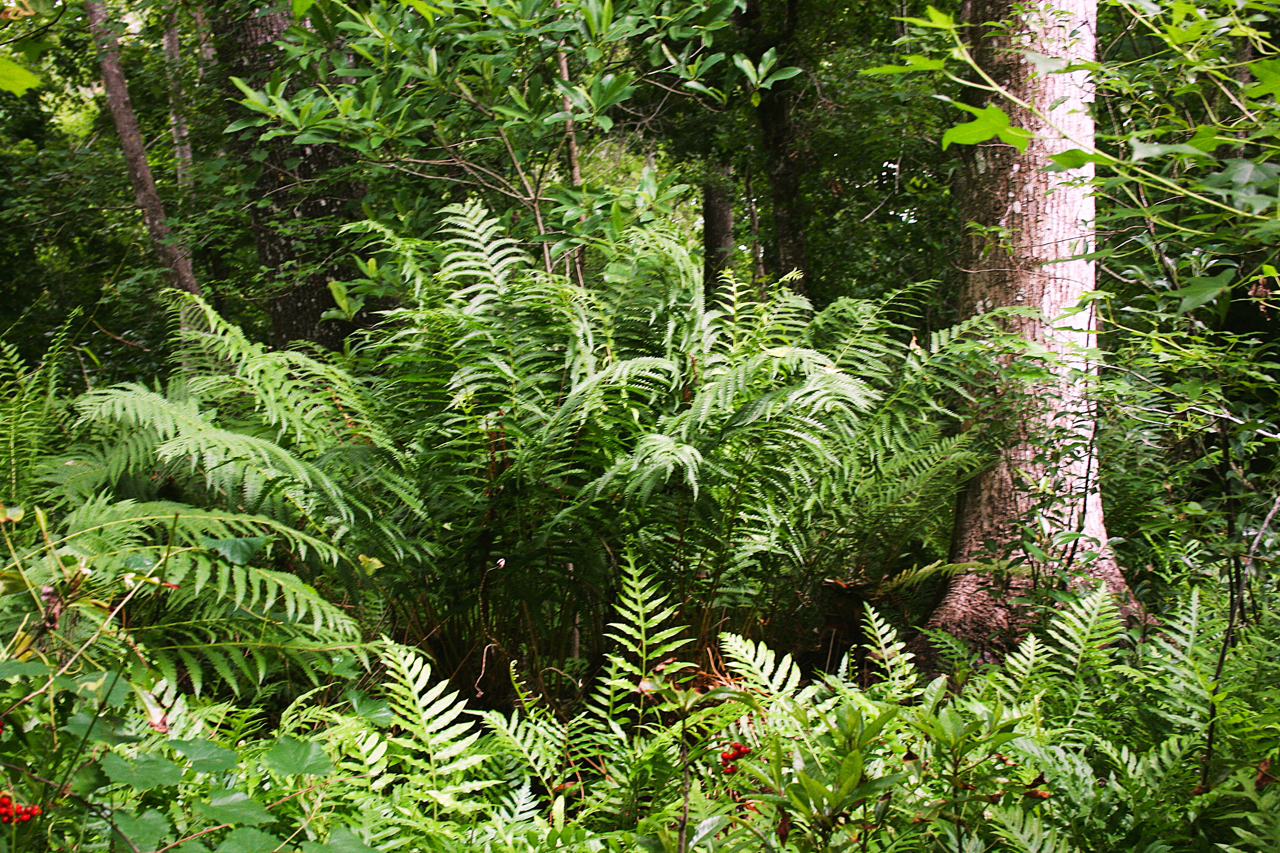
“Watching parts of old Florida be leveled to make way for the plans of an architect that has only experienced the land through board meetings hurts me down to the core of my soul,” said Conneally. “I know that some people may see forests of pine trees and saw palmetto as not much to look at, but these green spaces have a personality that could never be replaced by any amount of stucco and ‘rustic ambiance.’”
Most of those who spoke expressed concerns about the community’s character, strains on local resources, environmental effects, and the implications of rezoning a property previously dedicated as a greenspace with public input in the town’s Comprehensive Plan. A few also spoke in favor of the proposal.
Ryan Homes representatives stressed that they would be working closely with the Abbey during the development phase and intended to keep over 100 acres of the property as a natural conservation easement.
“This is going to be one of our showcase communities, a showcase destination. That means we’re going to spend more money on the … infrastructure of the amenities, [and]the landscaping,” said Ryan Homes in its opening statement.
In the rebuttal, Ryan Homes argued that denying the project was a violation of the owner’s property rights and that the golf course would inevitably be developed in some capacity in the future.
While most those who spoke wanted to see the development defeated, many also promised renewed support for the members of the Abbey who voted to sell the property. Conneally remarked that the community should financially support the Abbey, so the land would not need to be sold in the future.
In an Oct. 10, 2025 statement, the Benedictine Sisters of Florida affirmed their support for the St. Leo Abbey monks but “unanimously opposed” the golf course becoming a “large-scale development.” Burkee also made it clear that there is no enmity over this conflict, stressing that Saint Leo University supports the Abbey’s long-term financial stability and mission.
“They have been the soul of this community for generations,” said Burkee. “We want to be a good partner to them as they steward that land in a way that is consistent with the town’s comprehensive plan and their own values. That’s the conversation worth having.”
At the hearing, Burkee attended and delivered a well-received statement on the “conversation worth having”—whether small communities should retain the ability to shape their own future in the face of mounting development pressures.
“It was about whether small communities retain the right to govern themselves—or whether companies with deep pockets can pressure and intimidate towns into surrendering their identity,” said Burkee.
While Burkee strongly opposed the proposal, he stressed that he is not “anti-anything,” but felt that the plan and Ryan Homes’ approach didn’t fit the community.
“The developer never made a serious effort to engage the community—not the university, not the neighbors, not the town. That’s not how you build something in a place that has a history and a sense of itself,” said Burkee.
Burkee said he felt moved by the strong presence of community members. Furthermore, Burkee praised the Commission for resisting the pressures from companies with greater financial resources and the state.
“St. Leo is not a suburb waiting to happen. It is something rarer—a place built around faith, scholarship, and a genuinely different way of life. When that was threatened, people showed up. That says everything,” Burkee said.
That sentiment echoed throughout the nearly three-hour hearing. For many attendees, the vote represented more than a development dispute; it became a broader debate over whether small communities can preserve their identity amid rapid growth across Pasco County.
The Saint Leo Abbey declined to comment. At the time of publishing, Ryan Homes has not responded to a request for comment.