
By Elijah Penn, Staff Writer
“There’s one really creepy story … about a gentleman in Zephyrhills …. It was kind of like a Sleeping Beauty story: he exhumed a body. It’s a wild story … and it captured the national attention. The guy was clearly a sociopath,” said Madonna Wise.
Wise, a historian, educator, and author excitedly retold some of the creepiest legends that haunt Pasco County. Wise has penned several books across different genres, yet her true passion is local stories told from a personal perspective.
Wise found her passion for history when researching all the records she could find about her great-great-grandfather, who was murdered in a knife fight in Indiana. She and her husband, Ernest “Ernie” Wise, moved to Pasco County in 1974, where she served for forty years in local school districts. She and Ernie recently finished teaching six Osher classes at USF on local history.
In her most recent book, A Haunted History of Pasco County (a part of the Haunted America series), she has captured the spookiest stories across Pasco County from tales of gruesome deaths, mysterious apparitions, bloody feuds, and a man who stole the dead body of his love,whom he was forbidden to marry.
A Love that Never Dies
The Key West judge sat stunned as he listened to Georg Karl Tanzler pleading for the body of Elena Hoyos Mesa to be given to him.
Tanzler had stolen Mesa’s body and had kept it in his house for seven years before he was caught with the remains. He allegedly attempted to resurrect her with radiation and slowly reconstructed her body as she decayed.
Tanzler immigrated from Germany in 1922 following World War I where he assisted surgeons in reconstructing the disfigured faces of battle-scared soldiers. Moving to Florida, Tanzler soon found work at Marine Hospital in Key West.
It was there that he met the 19-year-old Cuban girl, Mesa, who was suffering from tuberculosis. To Tanzler, Mesa was the embodiment of a beautiful woman he had fantasized about while still in Germany. He applied himself to curing her malady with radium, the dangers of which were unknown at the time.
His attraction to Mesa only grew and he eventually proposed to her. This alarmed Mesa’s father who ordered the 54-year-old Tanzler to stay away from the family.
A Halloween parade in 1931 ended in tragedy when the young woman collapsed and died. Tanzler paid for a mausoleum for her body. It seemed like the end of the ill-fated relationship—but it wasn’t.
It wasn’t until 1940 that the papier-mâché, piano wire, and cheesecloth body, with its glass eyes,was rediscovered that authorities realized that Tanzler had stolen Mesa’s body from the mausoleum sometime after it was placed there.
It was this bizarre chain of events that led to Judge W. V. Albury questioning the sanity of the man before him, charged with grave robbery, who was begging for the body to be returned to him. The judge had no choice but to free Tanzler as the statute of limitations had run out on the crime, and he was found to be legally sane.
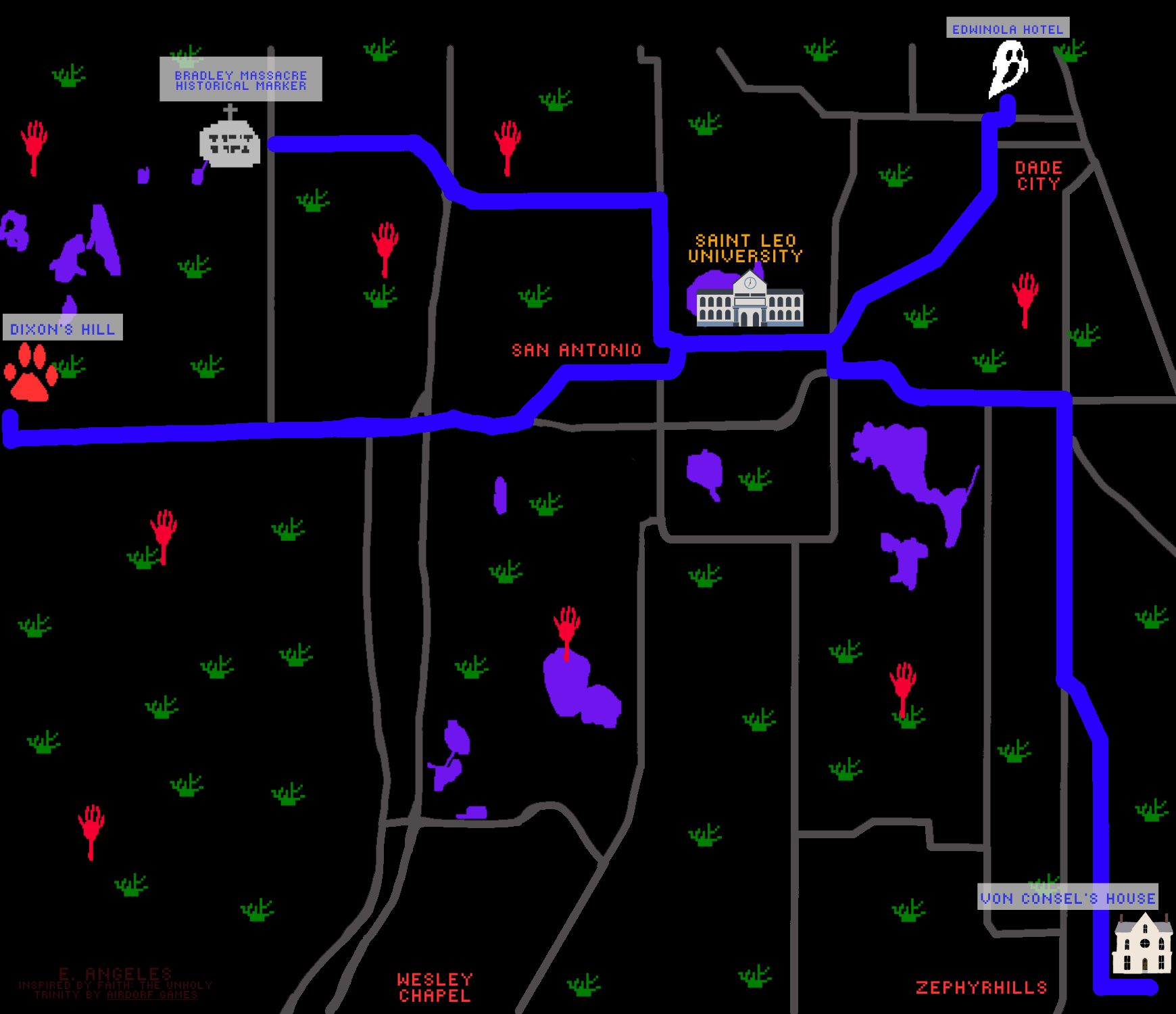
Now, without Mesa’s body, Tanzler relocated to Zephyrhills to be near his estranged wife. Rumors abounded in the town about the odd German man whose pipe-organ playing drifted down the street. He embraced the rumors, embellishing his back story, insisting on being called Dr. Carl von Consel and claiming to be a count.
In 1952, he was found to be dead in his home. His body had been there around three weeks before a neighbor became worried about his health, having not seen him in weeks, and noticedhis full mailbox. He was the only living soul in the house as his wife lived nearby in the city. However, he did not die alone, as a life-sized plaster effigy of Mesa’s body was discovered in the home.

In his book Von Consel, Tom Swicegood speculates that Tanzler may have secretly switched out Mesa’s real body for the replica, keeping her true remains for himself. We may never know, as when Mesa’s family got her body back, they buried it in a location which has not been disclosed to this day.
“I think he just got too much radiation in his brain,” Wise concluded.
Dixon’s Demise
The abandoned stagecoach was an odd sight to the four men who were walking along the remote wagon trail that ran from Tampa to Brooksville in 1853. There were no signs of life anywhere, but then the men saw something that made their blood run cold.
The sand was marred with signs of a struggle and blood. Yet this wasn’t an ordinary murder—it was predation. The tracks of a Florida panther could be seen.
Personal effects from the stagecoach revealed the unfortunate victim was John Dixon. On edge, the men followed a bloody drag mark from the hill. It led them to a murky swamp where they saw what was left of Dixon’s body. They were unable to recover his submerged corpse.
While there were no witnesses to Dixon’s terrifying last moments, what had happened could be deduced from the evidence at the scene. Dixon was last seen spending the night at a homestead along the trail on his way to Tampa. Weary, he decided to rest under a tree on the highest point amid the swampy terrain.

It was there that the panther found him, suddenly leaping upon him. The struggle ended quickly, and the panther took its meal before dragging off its kill.
In July 2025, Pasco County had the first recorded Florida panther death in modern history after one was struck by a vehicle in Wesley Chapel, reports the Tampa Bay Times.
While this is great news for the endangered species, there is no denying that panthers are ruthless predators.
Ghosts of the Bradley Massacre
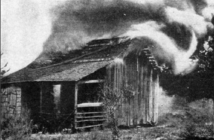
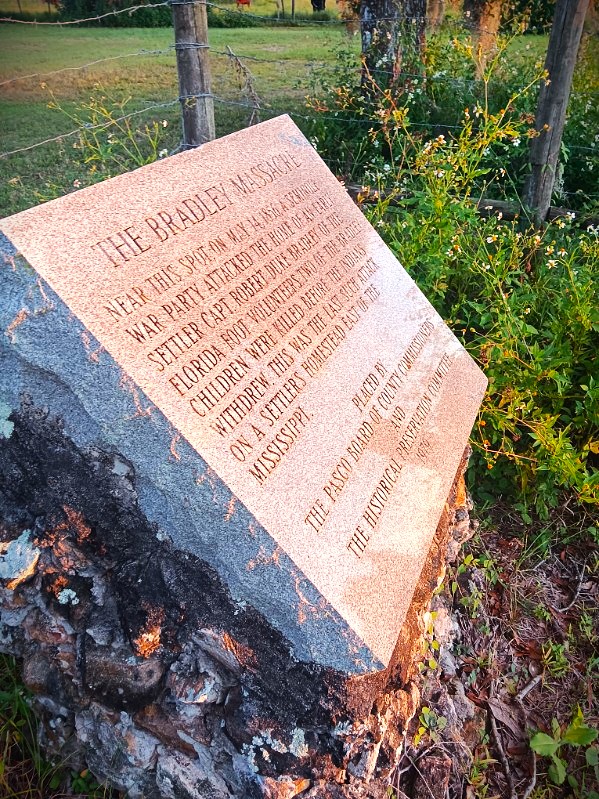
Gunshots rang outside the home of retired Captain Robert Duke Bradley. Bradley, bed-bound with malaria, ordered his 11-year-old daughter, May Jane, to lie down. In terror, she ran to the kitchen where her mother was. Though the unfinished chimney, she was shot through the heart and died instantly. Bradley’s 15-year-old son, William, was also struck twice with musket fire and soon died.
The Bradley homestead was attacked by a party of Seminole Indians, perhaps in revenge on Captain Bradley for having hunted down the brother of the famous Second Seminole War chief Tiger Tail.
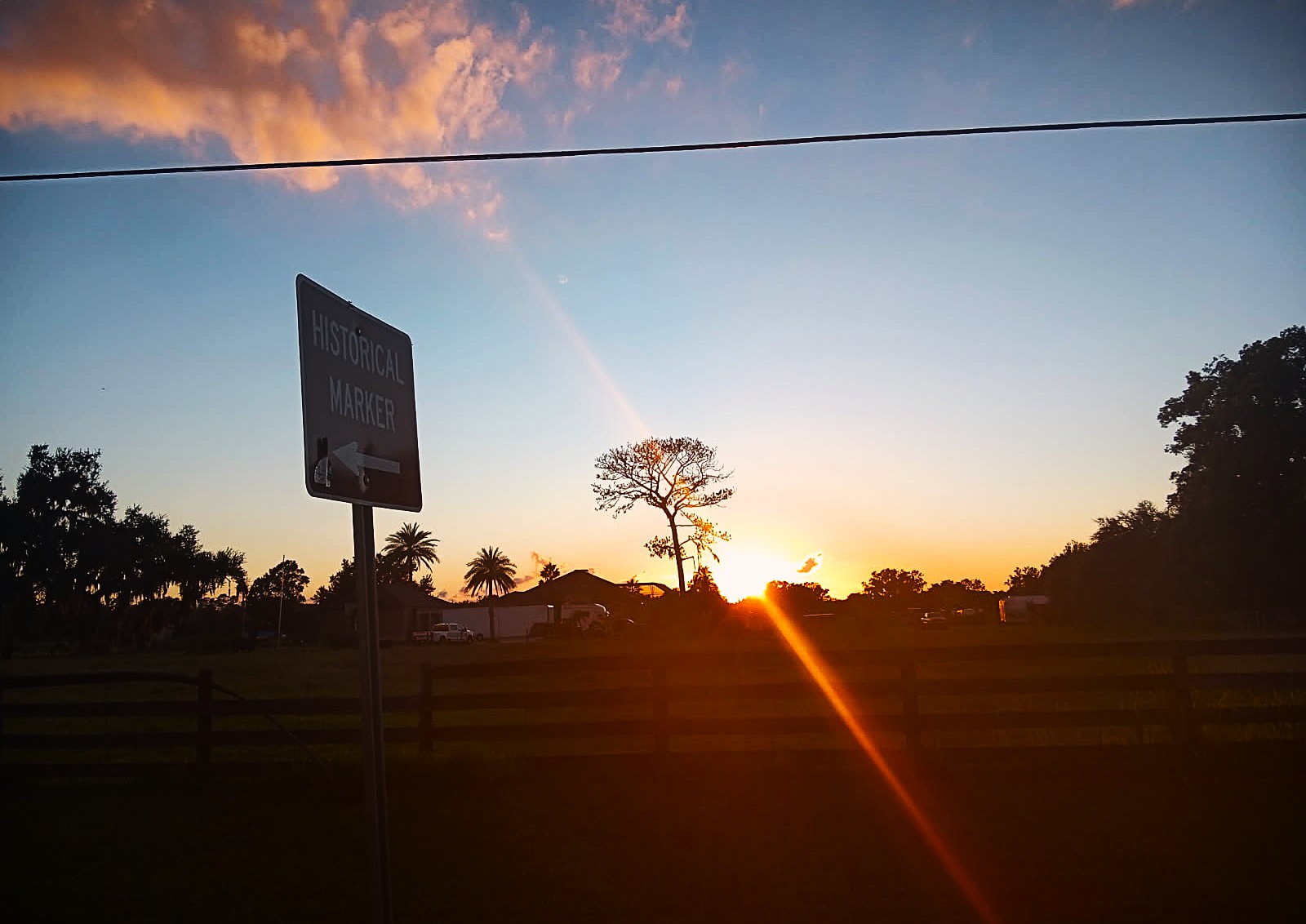
Historians believe the actual site of the massacre to have taken place along a lake in what is now Scream-a-Geddon Horror Park.
“There’s this low place, and that’s where, at the time, they were dancing around—these two ghosts,” Wise told how people had contacted her once they found out about the book, tellingabout their sighting of the ghosts of the Bradley’s children. “Some people feel very passionately about it.”
Ghostly Guests of the Edwinola
One moment, Seymour Gerowe was working on his dream hotel in downtown Dade City, and the next, he was plummeting thirty feet to his death.
Gerowe of Atlanta bought the Dade City property, where a few months earlier, a previous hotel had burned down, and excitedly began to build a new hotel. He soon became a well-known and respected figure in the community.
It was April 3, 1911, when Gerowe was on a third-floor window ledge pulling out nails left over from scaffolding. One particularly stubborn nail gave way suddenly, throwing Gerowe off balance.
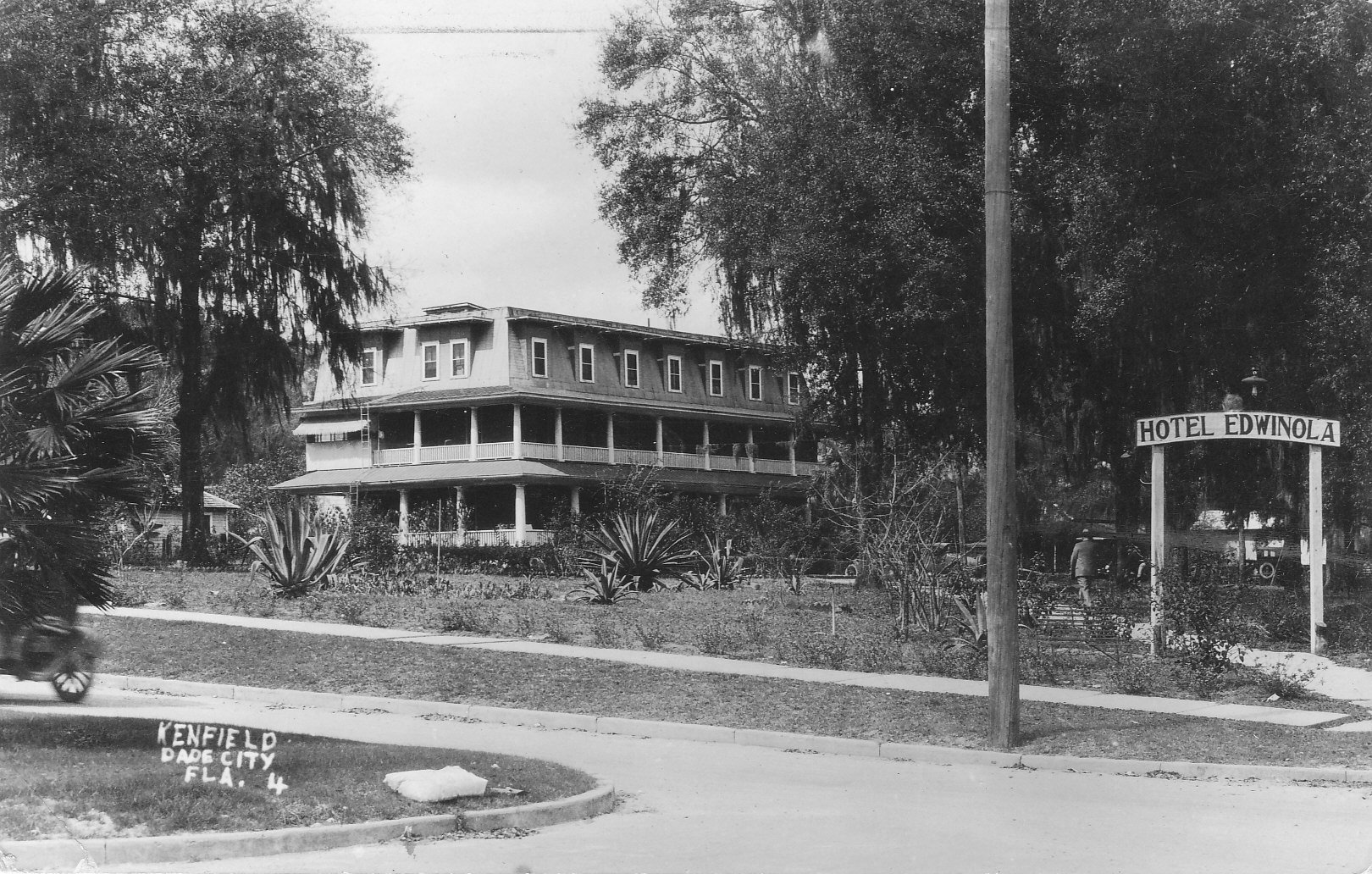
Terror filled Gerowe as he free-fell through the air, trying to somehow stop his fall. His fear was short-lived as he died instantly as his head hit the ground below and his neck snapped.
Ghostly activity has been reported in the Edwinola ever since. An unknown female apparition is reported to haunt the floors, and murmurs and cigar smoke rise from empty rooms. It is also believed that the park in front of the Edwinola was the place of a 1916 lynching of a black man accused of assaulting a white woman. No one was charged for the illegal lynching, so there are only local oral records, but what little documentation that does exist supports the rumor.